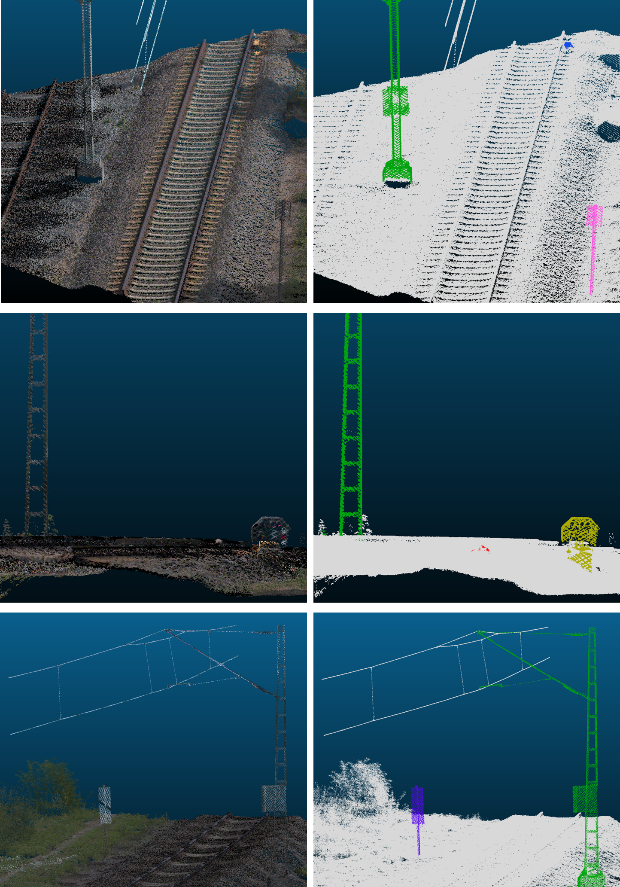
Asset data collection and maintenance are essential for construction and maintenance work on railway infrastructure. Using deep neural networks, the identification of infrastructure components can be automated directly from point cloud data, making this process—which has traditionally been performed manually—more efficient. The software solution, which is being developed as part of the innovation project “SIGNON InfraAI – Technical Equipment,” recognizes and locates objects, thereby significantly optimizing the capture and localization processes—for example, for planning or maintenance. Especially in times of skilled labor shortages and limited financial resources, it helps ensure the safety of rail traffic.
As part of the innovation project, the technical feasibility of automatically capturing selected LST objects in point clouds using segmentation networks was successfully demonstrated. The AI-based point cloud analysis developed is integrated into a process chain that covers the entire workflow, from measurement runs and post-processing of the raw data to the actual application. Six object classes were selected to demonstrate the feasibility of AI recognition: axle counters (AC), catenary masts (CAT), track magnets (MAG), advance warning beacons (Ne3), stop signals (SP), and Lf 7 speed signals (Lf7). The software makes it possible to automatically determine the positions and geometries of these objects and then compare them with the digital as-built plans. This allows objects that occur frequently and are difficult to identify in the point clouds to be detected and matched more quickly. In the future, this will significantly reduce both the analysis times and the costs of evaluating survey data.
Future developments are planned to expand the object catalog with additional object classes and attributes in order to map the current version of the Digital Rail Germany (DSD) inventory data specification as completely as possible. In addition, optimizations will be made to improve recognition accuracy and reduce computational load, and the software will be adapted for further areas of application. Measures to improve performance and reduce errors are currently being implemented intensively. Among other things, additional object classes are being trained and plausibility checks introduced to reduce misidentifications based on logical and spatial relationships between various elements (such as track magnets and light signals) as well as additional contextual information.
The completion of the most important optimizations and planned enhancements is scheduled for the end of 2025, at which point an initial production-ready software version will be available.